White ash vs grey ash: what ash colour tells a buyer
Key points
- Light grey to white ash usually means complete burning and low mineral content. Dark ash often means unburnt carbon.
- Ash colour is a quick visual check, not a lab result. Burn temperature, airflow and bowl set-up change it.
- Ash behaviour matters too: whether it holds the cube shape, falls into the bowl or turns gritty.
- Back every visual check with a measured ash percentage from a lab.
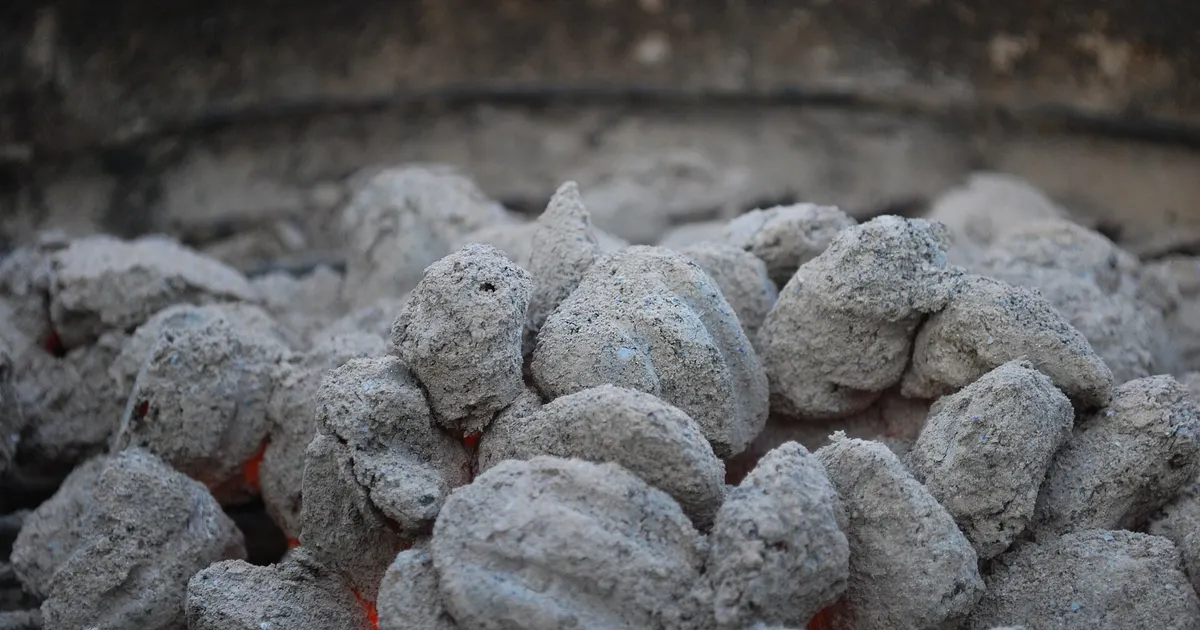
Open a shisha bowl or a grill after a session and the ash tells a story. Pale, fine ash on top of a cube that kept its shape reads as clean burning. Dark, patchy ash with black lumps suggests a problem. Buyers use this as a first check on sample cubes, and it is a useful one, as long as it is not mistaken for a measurement.
This guide explains what ash colour can and cannot tell you, and how to test it fairly.
What ash is
Ash is the mineral residue left when the carbon has burned away. It comes from three places: minerals in the coconut shell itself, soil or sand that stuck to the shell, and residue from the binder. A shisha spec often sets maximum ash around 2.5%, and premium grades target about 2% or less. BBQ briquettes usually allow more, often up to about 4%.
The colour of that residue depends on what it contains and how completely the carbon burned. Bright, light ash is mostly mineral oxides with little carbon left. Dark ash still carries carbon.
What the colour usually suggests
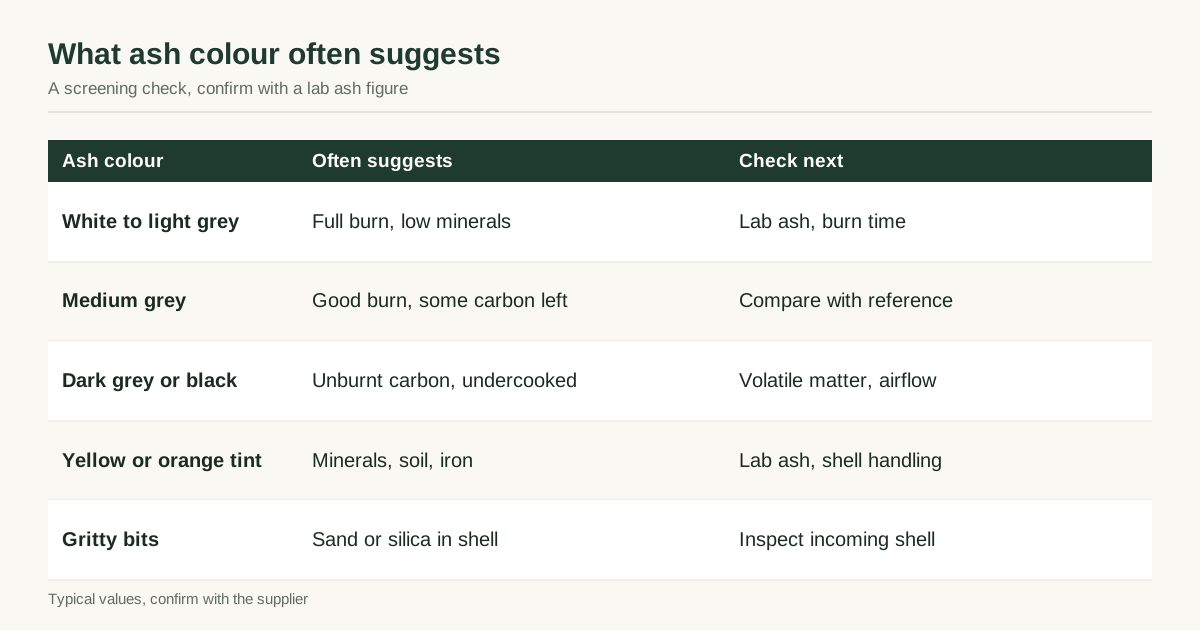
| Ash colour | What it often suggests | What to check next |
|---|---|---|
| White to very light grey | Full burn, low mineral content | Lab ash figure, burn time |
| Medium grey | Good burn with some carbon or minerals left | Compare with a reference cube |
| Dark grey or black patches | Unburnt carbon, early burnout, undercooked charcoal | Volatile matter, airflow in your test |
| Yellow, orange or brown tint | Minerals such as iron, soil or other contamination | Lab ash, look at shell cleaning |
| White crust with dark core | Surface burned, core went out | Cube density, airflow, test again |
| Glassy or gritty bits | Sand or silica in the shell | Inspect incoming shell and charcoal |
These are tendencies, not diagnoses. Treat colour as a flag that tells you where to look.
Why test conditions change the colour
Ash colour is easily changed by how you burn the cube.
- Temperature: a hotter burn removes more carbon and gives lighter ash.
- Airflow: a cube starved of air goes dark and may smoulder out.
- Heat management devices and foil: these lower the temperature and can leave darker ash.
- Burn duration: cubes that you remove early still hold carbon.
- Surface layer: ash on top can look white while the core is still dark.
If you compare two cubes, burn both on the same coil or burner, for the same time, in the same airflow. A fair comparison matters more than a single result.
Ash behaviour, not only colour
Look at what the ash does.
| Behaviour | Likely meaning |
|---|---|
| Ash holds the cube shape until touched | Good bonding, steady burn |
| Ash collapses early and falls into the bowl | Weak structure or high binder residue |
| Fine, soft ash | Low mineral content |
| Gritty ash | Sand or other mineral contamination |
| Large flakes that peel off | Uneven drying or pressing |
| Sparks and pops during burn | Moisture or gas trapped in the cube |
A cube that keeps a ghost shape of ash for the whole session helps the smoker, because the heat stays even and no ash falls onto the tobacco.
Colour is not a lab result
A visual check cannot give a percentage. Two cubes with the same pale ash can differ in ash content by a point or more. Ash content is measured by burning a known weight of dried charcoal at a set temperature and weighing the residue. Our guide to charcoal lab tests explains the method, the basis and how to read the report.
Use colour for screening and lab data for decisions.
What causes high ash in coconut charcoal
| Cause | How it enters | What reduces it |
|---|---|---|
| Soil and sand on shell | Handling and storage on bare ground | Sorting, brushing, covered storage |
| Husk fibre | Mixed collection | Better separation at source |
| Dirty quench water | Water used to cool charcoal | Sealed cooling |
| Charcoal raked on bare ground | Unloading | Clean surfaces and containers |
| High binder share | Recipe | Lower binder share, better powder |
| Other filler | Adulteration | Contract clause, testing |
Many of these are process choices that a good factory controls. See our guide to coconut shell carbonization for the kiln side.
A fair visual ash test
- Pick three cubes from different cartons.
- Light them together on one coil or burner.
- Burn them for the same time or until the glow ends.
- Let them cool without disturbing them.
- Photograph the ash on a neutral background with a ruler.
- Touch the ash gently and note whether it holds, crumbles or feels gritty.
- Keep the photos next to the reference cube photos from the approved sample.
Repeat on every lot. After a few lots you will recognise what a normal result looks like for your product, and you will spot changes at once.
Ash and the smoker’s experience
Ash colour matters for presentation as well. Lounge staff often judge a coal by the look of the ash in the bowl, and customers talk about “clean” burning. A brand that supplies charcoal with consistent pale ash gains a reputation for quality. A brand that sends dark, messy ash gains complaints, even if the lab numbers are within spec. Consistency from lot to lot is as important as the number itself.
Reading ash on different products
The same colour can mean different things depending on the product.
| Product | What ash usually looks like | Note |
|---|---|---|
| Shisha cube | Fine, pale ash that may keep the cube outline | Lowest ash target, so colour is most telling |
| Hexagon with hole | Pale ash, often a ring that holds its shape | Higher density gives a firmer ash shell |
| Flat or finger piece | Pale ash, collapses sooner | Thin pieces lose shape faster |
| BBQ briquette | Grey ash, more of it | Looser ash limit, so more residue is normal |
| Raw lump coconut charcoal | Light to medium grey, uneven | Not bound, so no ash shape |
Do not judge a BBQ briquette by shisha standards. A BBQ briquette with 3.5% ash will leave more residue and a greyer look than a shisha cube with 2%, and both can be within spec.
Three scenarios from real sample tests
These are typical patterns that buyers describe, not named cases.
Pale ash, but the cube burns out fast. The ash looks excellent, yet the cube lasts 40 minutes instead of 60. The likely cause is low density or low fixed carbon, not ash. Check piece weight and fixed carbon.
Dark ash with a slightly sweet smell. The cube lights slowly and leaves dark patches. This often points to a high binder share or short drying. Check moisture and the recipe.
Yellow tint in the ash on one lot only. Earlier lots were white. Something changed in the shell, the storage or the mix. Ask for the incoming charcoal test results and look at shell handling for that period.
In each case the ash was the clue, and the real answer came from the next check. Our guide to drying coconut charcoal briquettes and the guide to the binder in shisha briquettes cover two of the usual causes.
Keeping a visual record
A simple photo routine makes ash checks comparable.
- Use the same neutral background, such as a grey tile or white card.
- Place a ruler and a small label with lot number and date in each photo.
- Take photos from directly above and with the same light.
- Photograph the ash of the approved reference sample at the start and keep it.
- Store photos with the lab report for the same lot.
Over a year, this gives you a library that makes quality drift visible. It also gives you evidence if a customer complains about a lot that left your warehouse months ago.
Health and safety note
Never inspect burning charcoal in a closed room. Charcoal produces carbon monoxide, and tests should happen outdoors or in a room with strong ventilation. Wait until the charcoal is fully out and cold before handling ash, and dispose of it in a metal container. Wet ash can also be caustic to skin, so wear gloves if you clean up.
What to write in the spec
- Maximum ash percentage with the test method and basis.
- A burn test method for visual ash, including the equipment and the time.
- A reference photo set from the approved sample.
- A note that any change in ash colour or behaviour from the reference needs a retest.
- A clause against fillers and non-coconut charcoal, with a right to test retained samples.
Next step
Send us the sample you want to match, with its ash figure and a photo of the burned ash. We match your RFQ with up to 3 screened coconut charcoal factories that can show lab ash data and consistent burn results. Free for buyers, reply within 24 business hours. Send your RFQ.
FAQ
Is white ash a sign of good charcoal?
Often yes. White to light grey ash usually shows that the carbon burned off well and little mineral residue remains. It is not proof on its own, because airflow and temperature also change colour. Pair it with a lab ash figure.
What does dark or black ash mean?
It often means unburnt carbon, either because the cube went out early, burned at low temperature or was undercooked in the kiln. Re-test with better airflow before drawing conclusions.
Why is some ash yellow or orange?
Tints can come from mineral content in the shell or contamination, such as iron or soil. Strong tints deserve a lab check and a look at how the shell is handled before the kiln.
Can ash colour be faked?
A coated or treated surface can look light even if the core is poor. Look at the ash after a full burn and measure the ash percentage in a lab on a representative sample.